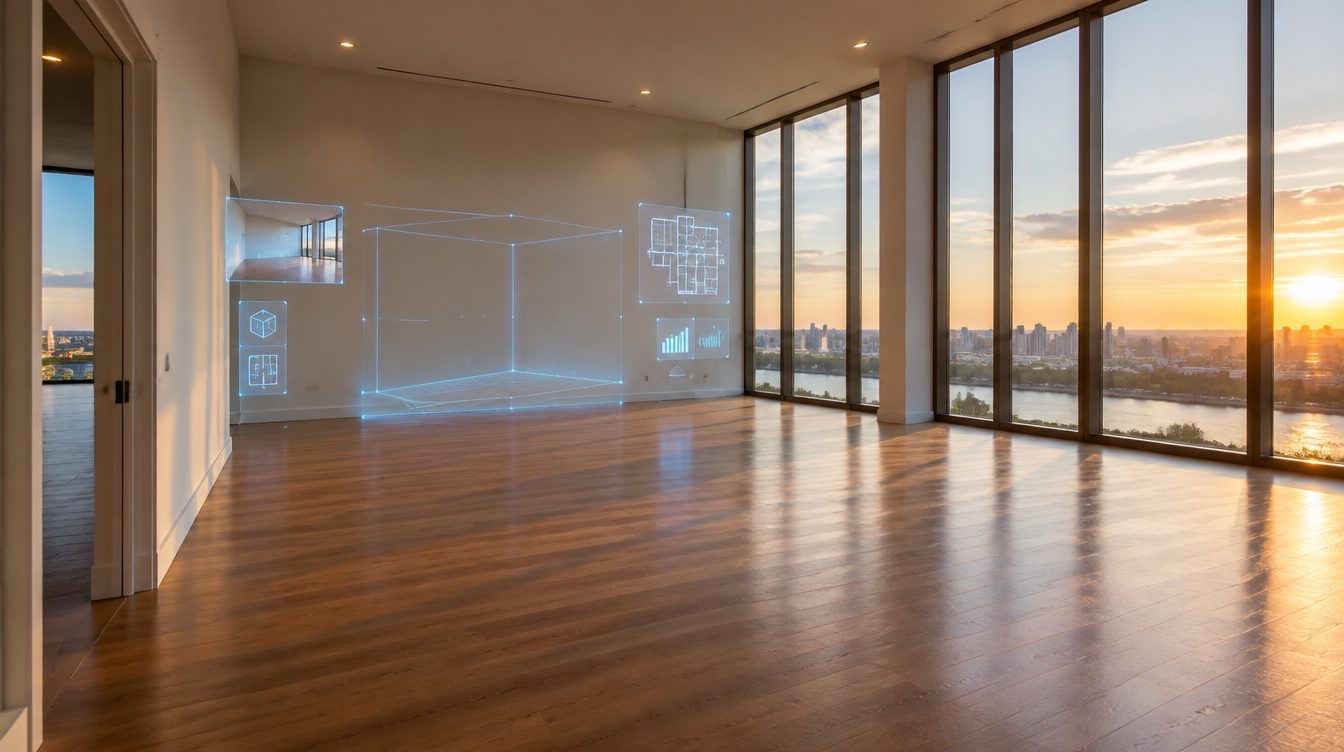
Shoot an empty house at 24mm or just under it, and stop reaching for 14mm. In a furnished room a sofa and a kitchen range tell the buyer how big the space is before they read a single number. Strip the furniture out and nothing in the frame has a known size, so the lens becomes the only scale cue left. An ultra-wide lens then reads as a bigger house, and the correction happens in the doorway on showing day, which is the worst possible place for it.
Working photographers have said this for more than a decade, and the rule books arrived at it from a different direction. NorthstarMLS requires that a listing video "accurately depict the property for sale and its vicinity." The 2026 REALTOR Code of Ethics requires a true picture in advertising. California's AB 723, the statute everyone cites here, does not reach your lens at all, which is the part most agents have backwards.
Why an empty room is the worst place to go wide
The clearest statement of the problem comes from practitioners. On Photography For Real Estate's thread on handling empty homes, photographer Ken Brown wrote that ultra-wide "is a trap on these since there isn't anything in the room to give it scale," and warned that without furnishings a wide shot can make a room look several times larger than it really is. Christian J Anderson, in the same discussion, put it more bluntly, using the trade shorthand for ultra-wide angle: "Don't shoot UFWA just to get more in the photo, this tends to never really look that great."
That is a different failure from the one people usually name. The familiar complaint about ultra-wide is edge distortion, which PFRE's founder Larry Lohrman catalogued years ago: perspective distortion in the corners, round objects turning oval, one seller calling his 16mm images "cartoon like." Lohrman put the point where the human eye stops agreeing with the lens at roughly 22 to 24mm effective, and said the farther below it you go, the worse viewers react. Edge distortion is a quality problem a buyer sees on screen. The scale problem they cannot see on screen at all. It appears when they walk in.
Furniture is what hides the scale problem in a staged house. The eye has no absolute sense of room size, so it reasons from objects it already knows. A queen mattress is 60 inches wide, a range is 30, and once those are in frame a lens that exaggerates the room exaggerates them too, which makes the exaggeration visible. Take them out and it has nothing to argue with.
The arithmetic, so you can check it yourself
How much the lens is doing is not a matter of taste, and it takes no test shot to find out. Horizontal angle of view on a full frame sensor is 2 x arctan(36 / 2f), and the width of wall a lens frames at a given distance is distance x 36 / f. Standing ten feet back from a wall:
- 24mm: 73.7 degrees horizontally, 15.0 feet of wall.
- 20mm: 84.0 degrees, 18.0 feet.
- 16mm: 96.7 degrees, 22.5 feet.
- 12mm: 112.6 degrees, 30.0 feet.
From the same standing position, a 12mm lens puts exactly twice as much wall across the frame as a 24mm lens does. Vertical coverage doubles with it, so the rectangle the lens projects at that distance holds four times the area. The room did not change. What changed is how much of it got compressed into one picture, and in an empty room nothing in the shot lets a buyer undo that compression in their head.
If you shoot a crop sensor, convert first
All of the above is full frame. On an APS-C body with a 1.5x factor, 16mm is a 24mm equivalent, so a crop-sensor shooter at 16mm is already at the conservative end rather than being aggressively wide. Micro Four Thirds doubles, so 12mm there is the 24mm equivalent. The number on the barrel is not the number that matters, and mixing the two is how people shoot far wider than they think.
The range photographers actually use, and the advice that contradicts it
PFRE's guidance on how wide is wide enough lands on "effective focal lengths roughly between 16mm and 24mm to be the 'sweet spot' for shooting interiors," and sets a floor: "at a minimum, you need to work at 24mm or below."
Not every source agrees, and the disagreement falls along a predictable line. Aryeo's guide to photographing vacant properties, published November 28, 2023, tells photographers to "use wide-angle lenses to capture as much of each room as possible," on the reasoning that showing the full area suits a vacant home better than tight shots. VirtualStaging.studio's piece on photographing empty rooms, dated August 24, 2026, says the opposite alongside a number: shoot "around 16 to 24mm on full-frame" or "10 to 16mm on crop sensors," and "avoid ultra-wide shots that stretch and distort the edges," because that distortion "exaggerates room size unrealistically." Those crop numbers convert to a 15mm to 24mm equivalent, so the two sets of figures agree almost exactly while the prose points in opposite directions.
The side that says capture as much as possible is optimizing for the thumbnail. The side that says stay at 24mm is optimizing for the showing. Only one of them has a rule book behind it.
What the MLS rule says, and what it does not
NorthstarMLS is a useful test case because it publishes both halves in writing. Its photo rules page, last updated October 9, 2026, says a photo "may not be digitally altered ('Photoshopped') to the point it no longer accurately reflects the property." Its video suite page, dated July 12, 2024, carries two separate requirements: the video "must accurately depict the property for sale and its vicinity," and it "must not be digitally altered in a manner that does not accurately reflect the property and its surroundings."
Read those closely and the lens question answers itself. Three of the four clauses are about digital alteration, and a focal length is not a digital alteration. The one that does reach a lens is the clause with no software in it: must accurately depict the property for sale and its vicinity. That duty attaches to the finished video whatever produced it, and a frame that makes a 12 by 14 bedroom read as a great room fails it without a single edit applied.
The same shape appears in the Code of Ethics effective January 1, 2026. Article 12 requires that REALTORS "shall be honest and truthful in their real estate communications" and "shall present a true picture in their advertising, marketing, and other representations." Article 2 says they "shall avoid exaggeration, misrepresentation, or concealment of pertinent facts relating to the property or the transaction." Neither mentions editing software, because neither needs to. Exaggeration is exaggeration whether it came from Photoshop or from a 12mm lens, and room size is about as pertinent a fact as a property has.
AB 723 does not reach your lens, and that keeps getting stated backwards
California's AB 723 added section 10140.8 to the Business and Professions Code and is now the most-cited authority in this conversation. It is also the wrong one for lens choice, and the statute says so itself. Its definition covers an image "that has been altered through the use of photo editing software or artificial intelligence" in order "to add, remove, or change elements in the image." A capture-time decision about focal length adds nothing and removes nothing. There is no edit to disclose.
The exclusion list makes the point twice over. An image is not a digitally altered image where only common adjustments are made, and the ones the statute names include "lighting, sharpening, white balance, color correction, angle, straightening, cropping, exposure," so long as they "do not change the representation of the real property." Angle and straightening are in that list. Correcting barrel distortion or verticals in post moves a photo toward accuracy rather than away from it, which is what the trailing clause tests for.
So the compliance picture runs the opposite way to what most vendor blogs imply. Fixing distortion afterwards is explicitly fine and needs no disclosure. Creating it at the lens is not a disclosure problem either, because disclosure is not the mechanism that governs it. It is an accuracy problem, governed by the MLS clause and by Article 12, and neither offers a disclosure line you can add to make the photo compliant. If your question is really about edits rather than optics, the detail on what counts as an AI-edited listing photo under AB 723 covers the statute's two duties and how to satisfy them.
What to do in the empty room instead
Put a known size back in the frame
You cannot add furniture, but most rooms already contain objects with standard dimensions. An interior door is usually 80 inches tall, a light switch sits around 48 inches, and stair treads run about 10 or 11 inches deep. Composing so a doorway, a window or a run of stairs stays in frame gives the eye something to measure against, and costs nothing. The weakest empty-room shot frames four bare walls and a floor, because there is no information in it beyond the walls.
Shoot from the corner at 24mm, not from the doorway at 14mm
Most of the pressure to go wider comes from standing in the wrong place. Backing into a corner and shooting across the long diagonal buys the depth a wider lens was going to fake, and buys it honestly. Where that still will not fit, two frames at 24mm from two corners show the space better than one frame at 14mm.
Give them a floor plan
Aryeo's guide makes the useful point that floor plans "provide a sense of scale and the sizes of different rooms." A floor plan does furniture's job with numbers instead of cues, and it moves the size question out of the photograph entirely. On a vacant listing it is the cheapest fix available, and it is also the fallback when the problem runs the other way and you cannot photograph the interior at all: in the only court decision on photographing a tenant-occupied listing the measurements were allowed while the photographs were refused, which is the starting point for getting usable photos of a tenant-occupied listing.
Stage it rather than stretch it
Adding a bed to an empty bedroom and shooting it at 24mm is the honest version of what an ultra-wide lens is attempting. It gives the buyer back the scale reference the room is missing instead of removing the last reason to doubt the frame. Virtual staging carries a disclosure duty in most rule books, a real obligation and an easy one to meet, and a disclosed staged photo at an honest focal length is a far safer document than an undisclosed 12mm one. The room-by-room version of this is in our guide to staging an empty living room virtually, and the rules and cost side sits in the complete guide to virtual staging for real estate listings. For everything upstream of the lens, including what to shoot and in what order, see the complete guide to real estate listing photos.
The video inherits whatever the lens did
This matters more for video than for stills, because a video cannot undo the capture decision. In ShowcaseVideos.ai the AI camera motion on a hero shot pins both ends of the clip to the real photograph: the start frame is the photo, the end frame is a crop of it scaled back up, and the model interpolates between them. Our own engineering notes state the consequence directly, that a clip "can never show a single pixel the photograph does not contain." That exists to stop the model inventing geometry, and it has a second effect worth knowing. A push-in can only narrow the frame, and nothing in the pipeline can widen it back toward what a 24mm lens would have seen.
So a 12mm photo becomes a 12mm video, permanently, and every platform you post it to inherits the problem. Virtual staging runs the other way. It is per room and opt-in, one credit for a staged room, and with staging switched off the pipeline's own stated behavior is that empty rooms render exactly as photographed. Photos come in from a Zillow or Redfin listing URL or from your own uploads, up to thirty per video, and there is no import from an arbitrary MLS link.
If you have a vacant listing on the market now, shoot it at 24mm, stage the rooms that need a scale reference, and start a free showcase video with the photos you already have.
Frequently asked questions
What focal length should I use to photograph an empty house?
A 16mm to 24mm effective focal length is the range experienced real estate photographers work in, and Photography For Real Estate sets 24mm or below as the minimum to work at. In an empty room, favor the long end of that range, because there is no furniture in the frame to reveal how much the lens is stretching the space.
Is using an ultra-wide lens on a listing against the rules?
No rule names a focal length, but several reach the result. NorthstarMLS requires that a listing video accurately depict the property for sale and its vicinity, with no mention of software, and the 2026 Code of Ethics requires REALTORS to present a true picture in their advertising and marketing. A frame that materially misstates room size can fail both with no editing at all.
Does California's AB 723 require me to disclose a wide-angle photo?
No. AB 723 defines a digitally altered image as one altered through photo editing software or artificial intelligence to add, remove, or change elements. Focal length is a capture decision and adds or removes nothing, so the statute's disclosure duties are not triggered. That does not make an exaggerated frame safe, it just means the statute is not the rule that governs it.
Can I correct the distortion in editing instead of changing lenses?
Correcting it is allowed and needs no disclosure in California, since AB 723's exclusion list names angle, straightening and cropping among the common adjustments that do not make an image digitally altered, provided they do not change the representation of the property. Lens correction does not recover the compression an ultra-wide introduced, so it is a cleanup step rather than a substitute for a sensible focal length.
Should I virtually stage an empty room instead of shooting it wide?
Staging and honest framing solve two halves of the same problem, and staging is the half that gives a buyer back the scale reference. It carries a disclosure obligation in most MLS rule books, which is straightforward to satisfy. An ultra-wide frame carries no disclosure option at all, which makes it the riskier choice.
Will the video make the room look bigger than the photos do?
Not in ShowcaseVideos.ai. The AI camera motion is built around crops of the real photograph, so a clip cannot show anything the photo does not already contain and a push-in can only narrow the frame. The video is as accurate, or as exaggerated, as its source photo.