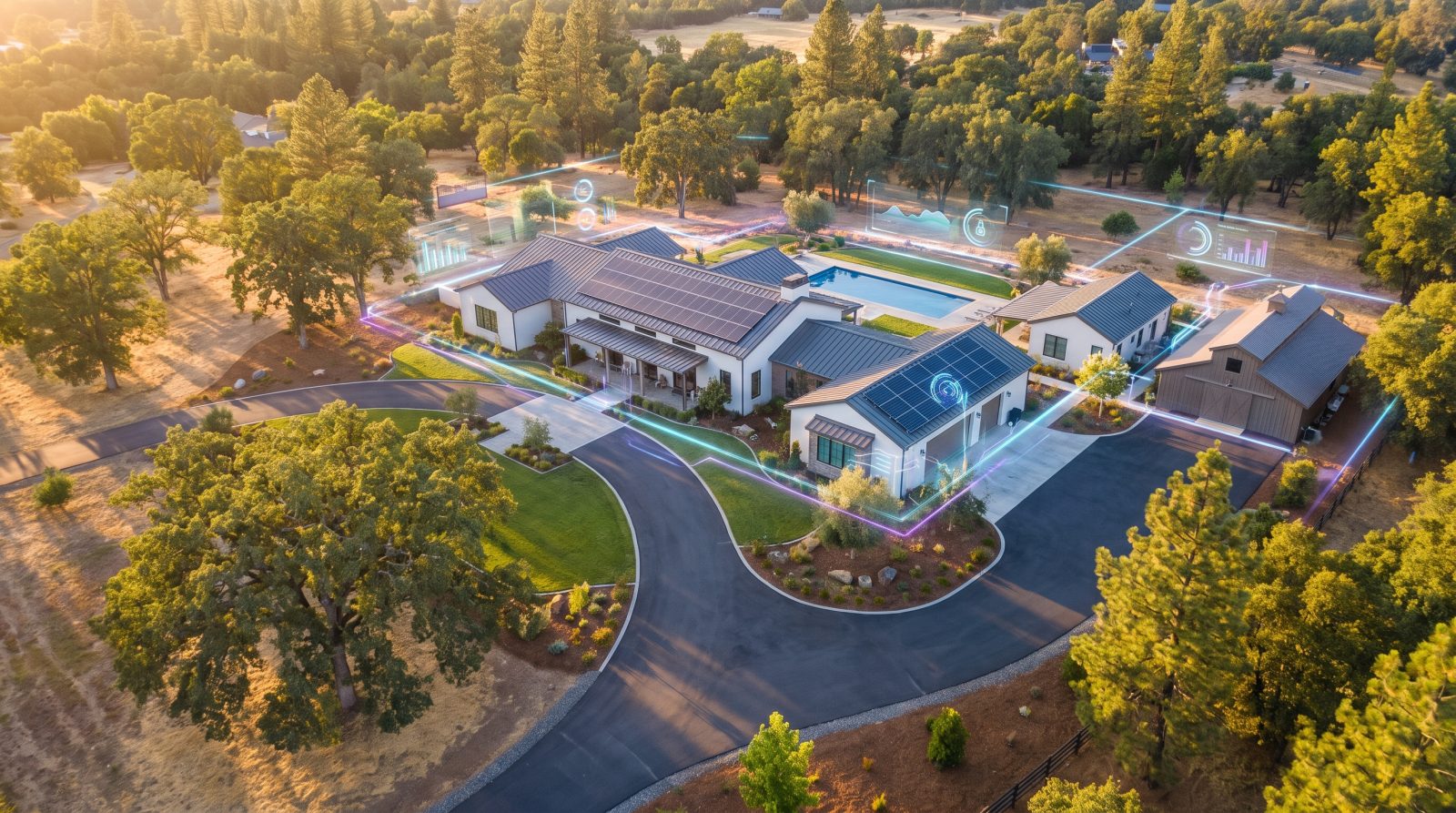
A drone shoot for a listing runs about $250 to $600, but the number that decides whether to spend it is on the listing, not the invoice. Aerial earns its cost when the land, the setting or the roofline is part of what the buyer is purchasing. On a 0.15 acre lot with neighbors eight feet away, an aerial shot mostly shows the neighbors. AI camera motion applied to still photos costs a fraction of that and puts movement on every room in the house, but it cannot manufacture a view of acreage nobody photographed. For most agents the answer is one of them on every listing and the other on maybe one in ten.
What a drone shoot actually costs in 2026
Published prices beat the ranges recycled across marketing blogs, so here are two operators who put numbers on a page.
HomeJab publishes flat rates that do not move with square footage. Their drone package is $250 and includes 15 drone photos plus drone video, and their own copy says the price holds "no matter the square footage of the property or the photographer's amount of time spent at the shoot." Photos Plus, which pairs ground-level photography with drone stills, is $295. The Premium package with interior, exterior, drone imagery and a video walkthrough is $395. Ultimate Luxury, with HDR stills, aerial and a drone-inclusive walkthrough, is $585.
Vantage Aerial Works publishes a guidance table rather than a rate card, worth saying plainly because it estimates the market rather than binding them to a price. Their bands: $150 to $300 for five to ten edited stills, $250 to $400 for fifteen to twenty-five, $350 to $600 for stills plus a one to two minute video, $450 to $800 for a full package with a floor plan attached. Add $50 to $100 or more in travel for rural properties and $50 to $150 for same-day turnaround.
Working range for stills plus a short aerial video: roughly $250 to $600 in most markets, travel and rush on top. Cheaper usually means a newer pilot building a portfolio. More expensive usually means buying a cinematographer rather than a drone operator. Those numbers buy a specialist with an aircraft, and the same labor arithmetic sets the floor under a ground-level shoot, which is worked through in what a listing video actually takes when you do not hire a videographer.
The costs that never appear in the quote
If you are thinking about flying yourself, the certificate is the cheap part and the ongoing obligation is the real one. The FAA requires that you be at least 16, pass the Unmanned Aircraft General knowledge exam, clear a TSA security background check, and complete online recurrent training every 24 calendar months to stay current. A registered drone also has to comply with Remote ID under 14 CFR part 89, by broadcasting natively, by carrying a broadcast module, or by flying inside an FAA-Recognized Identification Area.
Then there is airspace. 14 CFR 107.41 is one sentence and it catches agents out: "No person may operate a small unmanned aircraft in Class B, Class C, or Class D airspace or within the lateral boundaries of the surface area of Class E airspace designated for an airport unless that person has prior authorization from Air Traffic Control." If your listing sits under that airspace you need authorization through the FAA's LAANC system before launching, and a property near a regional airport can be a scheduling problem rather than a formality.
14 CFR 107.51 caps you at 400 feet above ground level, with an exception allowing more when you are within a 400 foot radius of a structure and stay within 400 feet of its uppermost limit. That ceiling shapes the shot. The wide establishing view showing a property in its valley is often a 300 to 400 foot shot and it is legal. The satellite-style overhead showing five neighboring parcels usually is not.
How many agents are actually doing this
The 2025 REALTORS Technology Survey puts drone photography and video at 75 percent adoption, tied with social media and behind eSignature at 79 percent. It was fielded in July 2025, drew 1,241 usable responses from 49,233 invited members, and carries a margin of error of plus or minus 2.78 percent at 95 percent confidence.
Worth flagging: NAR's own drones resource page currently says 52 percent and attributes that number to the 2025 Technology Survey. The 52 percent figure does not appear in the 2025 report. If you have seen both numbers quoted at you, that is why. The 75 percent figure is the one in the published survey.
The same page carries a claim you will see everywhere, that "homes displayed with aerial shots are 68% more likely to sell." Follow NAR's own footnote and it lands on a March 2023 post on a drone industry blog, which credits the figure to "the MLS" without naming an MLS, a market, a sample or a period. There is no methodology to check, so we are not using that number and neither should you in a listing presentation where a seller might ask where it came from.
When a listing genuinely needs aerial
Agent opinion ties to the property rather than to a general belief that video helps. In a long-running BiggerPockets thread on hiring drone operators, the agent who gave concrete examples cited listings at $2,549,900 and $3,290,000 as the ones where aerial "looks great." Treat that as dated anecdote rather than data, because a forum thread is what it is. The useful part is the shape of the answer: the endorsement is attached to a price point.
Here is a more practical test than a dollar threshold. Aerial pays for itself when at least one of these is true:
- The land is the product. Acreage, pasture, a treeline, water frontage. Nothing at eye level conveys twelve acres.
- The setting sells the house. Golf course, ridge line, lake view, a lot backing onto protected land. The buyer is paying for what surrounds the house and only altitude shows it.
- The roof or footprint is a question. A new roof you want to prove, outbuildings, an ADU whose relationship to the main house is confusing from the street.
- Access is the story. A long private drive, a gated entrance, a hillside approach.
- The listing competes at the top of its market. Not because aerial sells the house, but because at that price its absence reads as an under-marketed listing.
The cases where you are burning $300: a tract home on a small lot, a townhouse or condo, an interior unit, and any listing whose surroundings are the weakest thing about it. An aerial is an honest wide shot. If the wide shot hurts, do not buy the wide shot.
What AI camera motion on a still photo can do
AI camera motion is a different tool with a different job. An image-to-video model takes one still photo and generates a short clip with real camera movement in it, so a kitchen photograph becomes a shot that pushes gently into the room with actual parallax rather than a flat digital zoom.
Here is how it works inside ShowcaseVideos.ai, since the numbers are more useful than a description. A job takes up to 30 photos. The system gives real AI motion to two fifths of them, capped at 12 clips, so a 20-photo listing gets 8 animated shots and a full 30-photo listing gets 12. Each animated clip is five seconds and runs on Kling 2.5 Turbo Pro as the image-to-video model. Every remaining photo gets a Ken Burns move instead, which costs nothing and still reads as movement rather than a slideshow. The finished 16:9 hero cut lands around 127 seconds with an address and price lower-third over it.
Pricing is credit-based and one credit is pegged to five cents of vendor cost, which makes the arithmetic checkable rather than a marketing figure. The base render is 18 credits. Each AI motion clip is 7, because the Kling clip costs $0.35 and $0.35 divided by $0.05 is 7. A virtually staged room is 1. A vertical 9:16 cut for Reels is 6, a square 1:1 cut is 4, an AI-composed score is 4, and library music is free. That vertical cut is a separate edit rather than a crop of the landscape file, and the reasons why, along with the specs the platforms actually publish, are in the guide to turning one set of listing photos into Reels and TikToks.
So a typical 20-photo listing video is 18 for the base render plus 8 motion clips at 7 each, which is 74 credits. The Agent plan is $59 a month for 190 credits, so a credit works out to about 31 cents and that video costs roughly $23 of your monthly allowance. Unused plan credits roll over for two months. Compare that to $250 for a drone package and the gap is not close, but the two are also not doing the same thing, which is the point of the next section.
What AI camera motion cannot do
It cannot give you an aerial. A model animating a ground-level photo has ground-level information and nothing above the roofline, so there is no honest way to produce a view of the whole parcel from a shot taken in the driveway. If the listing needs to show twelve acres, you need a drone or a photo taken from one.
It also cannot travel further into a space than the photograph contains, and pushing it to try produces an instructive failure. The setting controlling how hard the motion model follows its prompt shipped at 0.75 and was pulled back to 0.6 within a day, because a render at 0.75 hallucinated a full swimming pool out of a dining table and a rug. Pushed to travel deeper into a room with nowhere further to go, the model invented geometry, and a glossy tabletop beside a rug is exactly the ambiguous surface that gets reinterpreted as water. It now sits at 0.6 with an explicit no-pool guard in the prompt. Watch the animated clips before publishing, because dark and reflective surfaces are the highest-risk inputs.
Two more limits. The model animates what was photographed, so a room shot badly animates badly and photo quality still governs the result. And you cannot generate an exterior view from an angle nobody stood at, so the front elevation you have is the one you get.
The combination most agents should actually run
The version that works is not either-or. Hire the drone on listings that need altitude, then feed those aerial stills into the video alongside the interiors and let AI motion carry the rest of the house.
That works because photos come in from two paths. You can import a photo set directly from a Zillow or Redfin listing URL, the two portals the importer handles. Photo upload is always available as the fallback, and it is the path that matters here, because your drone stills are not on the portal yet when you are building marketing for a new listing. Upload the aerials with the interiors and they become shots in the same video.
The order of operations that keeps costs sane: run AI motion video on every listing, because at roughly $23 of plan allowance there is no listing where it fails to pencil. Add the drone shoot only where one of the five conditions above is true. On twenty listings a year with three that genuinely need altitude, that is about $750 in drone work rather than $5,000, and every listing still gets a video with movement in it.
One note on sequencing. Finished videos stay editable for 30 days at re-render cost only, so aerials that arrive after you published can be added without paying for the job twice. Get the video live the day the listing goes active and fold the drone shots in later.
How this changes the listing presentation
The seller conversation gets easier once the two line items are separate. Video with camera movement on every room is table stakes. Aerial is a specific spend with a nameable reason: the eleven acres, the ridge line, the new roof. Sellers accept a $300 line item with a stated purpose more readily than a vague premium marketing package.
If you are still deciding which tool belongs in your workflow, the complete guide to making a real estate listing video covers the full production sequence from photos through delivery, and the buying guide to AI real estate video generators compares what the current tools actually produce. For the mechanics of getting stills to move well, turning listing photos into cinematic video goes deeper on shot selection.
Frequently asked questions
How much does a drone video cost for a real estate listing?
Roughly $250 to $600 for stills plus a short aerial video from a published-price provider, with rural travel fees of $50 to $100 or more and rush fees of $50 to $150 on top. HomeJab prices a drone package at a flat $250 and its luxury package at $585.
Do I need an FAA license to fly a drone over my own listing?
Yes, if you are flying in furtherance of a business, which marketing a listing is. That means a Part 107 remote pilot certificate: pass the Unmanned Aircraft General exam, clear TSA vetting, register the aircraft, comply with Remote ID, and complete recurrent training every 24 calendar months. Hiring a pilot moves the obligation to them, and NAR advises verifying certificate and insurance before booking.
Can AI camera motion replace drone footage?
No, and anyone telling you otherwise is selling something. AI motion animates a photograph that already exists, so it adds movement and parallax to interiors and ground-level exteriors but cannot produce a viewpoint from 200 feet up that nobody photographed. What it replaces is the videographer walking the house with a gimbal, not the pilot.
Is drone footage worth it on a normal suburban house?
Usually not. On a small lot with close neighbors the aerial mostly shows the neighbors, and it can weaken the listing by revealing how tight the parcel is. Spend on interior video and photography instead, and save aerial for land, setting, roofline and the top of your price band.
How high can a drone legally fly over a property?
400 feet above ground level under 14 CFR 107.51, with an exception permitting more when you are within a 400 foot radius of a structure and no more than 400 feet above its uppermost point. In Class B, C, D or surface-area Class E airspace you also need prior ATC authorization at any altitude.
Can I use my own drone footage inside an AI listing video?
Yes. Upload the aerial stills alongside the interior photos and they become shots in the same video. Photo upload is always available, which matters because new drone shots will not be on a Zillow or Redfin page yet when you are building the marketing.
Where to start
The cheapest way to find out whether AI motion covers a listing is to make one and look at it. Every plan starts with a free showcase video and no card is required, so you can judge the output before deciding whether the property also needs a pilot. Make your first listing video free, upload the photos you already have, and see what the aerial gap looks like on your own property before you book one.