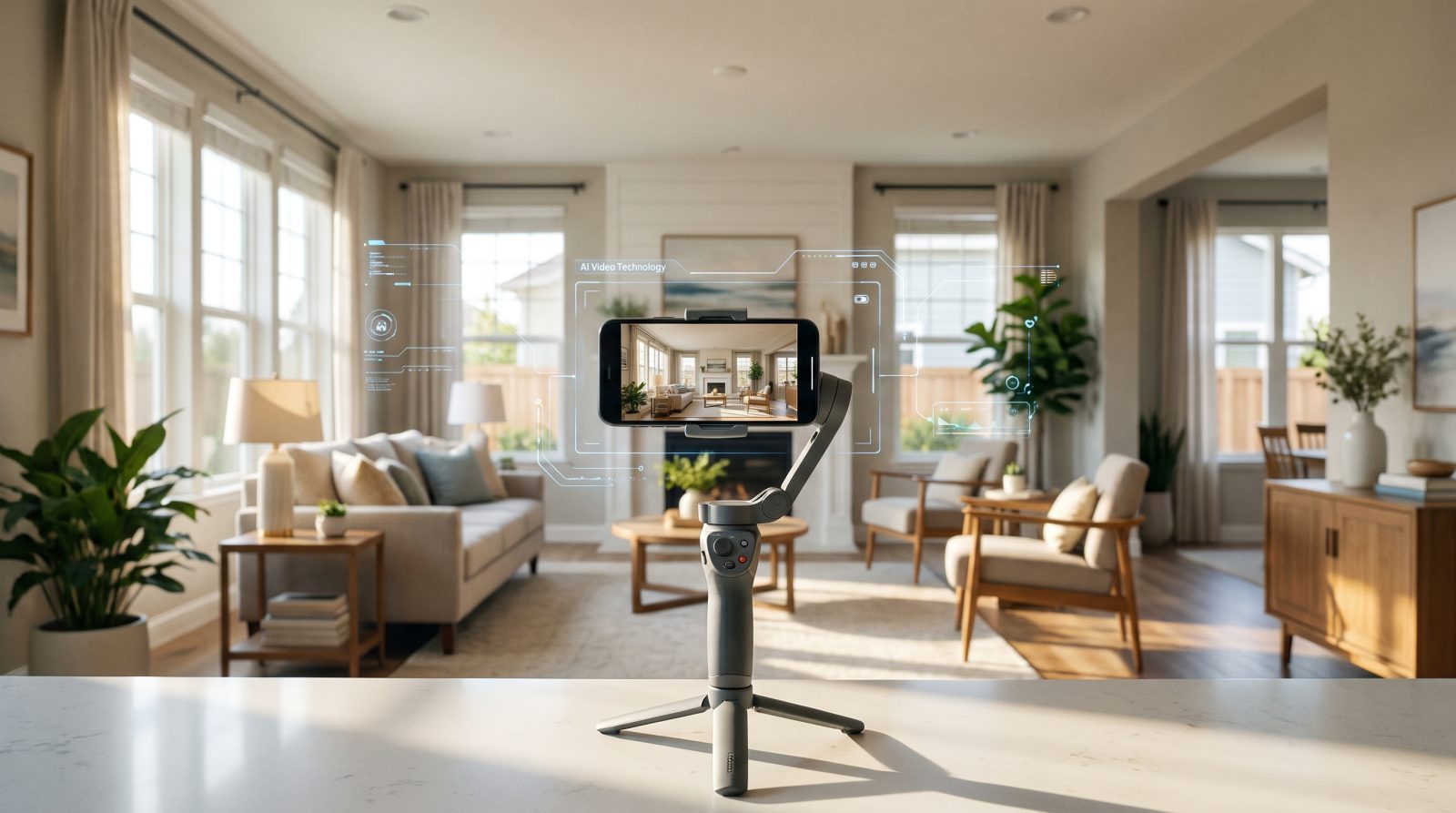
You can put video on a listing without hiring anyone, and on most listings you should. The real decision is which of three paths you take, because they differ far more in your time than in your money. Filming it yourself on a phone costs almost nothing in cash and roughly half a day per listing once the edit is counted. Template apps shorten the edit but leave the filming to you. Building the video from the listing photos you already paid for removes both jobs, and gives up the shots that only a camera inside the house can get.
Why a videographer costs what a videographer costs
The alternatives only make sense once you know what the thing you are replacing is made of. The U.S. Bureau of Labor Statistics surveys employers rather than scraping job ads, and its May 2025 Occupational Employment and Wage Statistics put the mean hourly wage for camera operators in television, video and film at $40.01, with a median of $36.05 across 21,550 people employed nationally. Film and video editors come in at a mean of $41.41 an hour, median $36.26, across 25,610 people. The Occupational Outlook Handbook puts median annual pay at $74,990 for camera operators and $75,420 for editors, both as of May 2025. Most of the per-hour figures circulating in this niche come from job-advertisement aggregators instead, which is a different and weaker kind of number.
Run the arithmetic on a modest listing shoot. Two hours on site, an hour of travel and setup, three hours in the edit. That is six hours, and at the survey mean it is about $240 of labor before anyone pays for a camera body, a gimbal, insurance, editing software, or the hours nobody bills for. The Handbook also reports that 35 percent of people in these occupations are self-employed, which means the person quoting you is usually a one-person business whose rate has to cover an unbillable half of the week.
So when a quote for a cinematic listing piece lands north of $400, that is not markup. It is the job. And when a quote lands well under that, what you are usually buying is a shorter shoot and a template edit rather than the same work at a discount. Knowing that makes the three alternatives easier to judge, because each of them attacks a different part of that six hours.
Path one: film it yourself on a phone
The camera is not the obstacle. Apple's published specifications for the iPhone 17 Pro list 4K Dolby Vision recording at up to 120 fps, Action mode up to 2.8K at 60 fps, and second generation sensor-shift optical stabilization. That sensor is better than most of what was shooting listing video professionally five years ago.
Movement is the obstacle. Handheld footage walking down a hallway reads as amateur within two seconds, because the human eye is extremely good at spotting a bobbing horizon. Sensor-shift stabilization corrects small shake, not a walking gait. The usual fix is a mechanical gimbal, and the common one in this category is the DJI Osmo Pocket 3, listed at $499 on DJI's own store, with a 1-inch sensor and a three-axis mechanical gimbal.
What this path really costs
Cash is the easy part. Call it $0 if you already own a recent phone, or about $500 if you buy the gimbal. The expensive input is time, and here is our own estimate rather than a published statistic: budget three to five hours per listing for your first several, including reshoots, and expect it to settle around two hours once you have a shot list you repeat house to house. That is not a discount against the videographer's six hours. It is the same work moved onto your calendar, at whatever your hour is worth.
The other cost is consistency. A videographer delivers the same look every time because that is their whole job. Your third listing will look better than your first, which is good for you and slightly awkward for the seller who got the first one.
Adding aerial to a self-filmed listing
Flying a drone for a listing is a commercial operation, so the FAA requires a Part 107 remote pilot certificate. The FAA's own requirements for becoming a certificated remote pilot are a minimum age of 16, the Unmanned Aircraft General knowledge exam, a TSA background check, and free online recurrent training every 24 calendar months. The FAA also states that testing centers charge approximately $175 for the initial knowledge test. That is a real but small barrier. The harder question is whether aerial changes anything on the specific house, which we worked through separately in what a drone shoot actually costs against AI camera motion.
Path two: template apps
Template tools sit between filming and editing. You still walk the house with a camera, but the app supplies the timing, the captions, the transitions and a music bed, so you drop clips into slots instead of building a timeline.
They genuinely cut editing time, often by half. What they do not touch is the shoot, which is the part that requires you to be physically inside the property with the lights on and the blinds open. If your bottleneck is the two hours on site, a template app does not help.
The second issue shows up around listing number five. Templates are shared by everyone using the tool, so a scroll through your local market starts to show the same transitions and the same caption animation on every agent's video. For social cutdowns from footage you already have, they are a reasonable tool. As the primary way you produce listing video, they leave you doing the expensive half of the work.
Path three: build the video from the listing photos
The photos already exist. Someone shot them, someone paid for them, and they are sitting on the listing page doing one job. Turning that set into a moving piece removes both the shoot and the edit, which is why this path collapses six hours into minutes.
In our own product that means pasting a Zillow or Redfin listing link and letting the photo set come across, or uploading the files directly, which is always available and is what you want when the shots you need were never posted to the portal. Note the scope. Zillow and Redfin, not "any MLS link," and a tool claiming to read any MLS URL is worth a hard question.
Pulling a gallery cleanly is harder than it sounds, and how a tool handles it tells you whether anyone did the work. Portal pages carry photos of other houses on the same image CDN under the same URL shape, for the nearby homes and similar homes modules. On one real Zillow page we counted 1,111 CDN image hits against 31 genuine gallery photos. A tool that sweeps the page blindly imports somebody else's kitchen into your seller's video without telling you. Ours reads the structured payload scoped to the single property first and only falls back to a bounded sweep, and the Zillow path is the one we have confirmed end to end against a live listing, at 31 photos out of 31, on August 8, 2026.
What comes out
A job takes up to 30 photos. The finished widescreen cut runs around 127 seconds with an address and price lower-third over it and a library music track under it. A share of the photos get real AI camera motion rather than a pan across a still: the count works out to two motion clips for every five photos, capped at 12, so a 20-photo listing gets 8 motion shots and a full 30-photo listing gets the ceiling of 12. Everything else gets a slower Ken Burns move at no extra cost. Empty rooms can be virtually staged before the render.
The first video is free, uses every photo in the listing, carries a small watermark and does not ask for a card, which is enough to judge the output before deciding anything. Plans run $59 a month for Agent, $239 for Office and $699 for Brokerage, lower on annual billing, and unused plan credits roll over for two months while credits bought as a top-up never expire. Agent delivers the widescreen cut; the vertical 9:16 and square 1:1 cuts are an Office feature. You have 30 days after a render to change a finished video and re-render it cheaply. The full credit breakdown per video is in the drone comparison linked above, and the questions worth asking any vendor in this category are in the buying guide to AI real estate video generators.
What this path cannot do
It cannot show a room the photographer did not shoot, and it cannot walk a buyer through the flow of the house, because there is no continuous camera path between frames, only cuts. You will not appear on screen. Nothing outside the photo set exists, so the street, the school two blocks over and the four o'clock light through the kitchen are all missing unless somebody photographed them. Where one of those is the actual point of the video, this is the wrong path and the shoot is worth paying for.
What none of the three replaces
A videographer is still the right call for the video that is about you rather than about a house. Agent brand films, seller testimonials, market updates you appear in, listing presentations for a $3M property where the seller is partly buying your production values. Those are performances, and performances need a person behind a camera who knows how to light your face and cut around a stumble.
Most agents overspend on the listing side, underinvest on the brand side, and then conclude that video does not pay.
Choosing a path without overthinking it
A rule that holds up across most books of business: run photo-to-video on every listing, because at a few dollars of production cost per property there is no listing where it fails to pencil, and add a filmed shoot only where a specific reason exists. Those reasons are real. A property whose selling point is a view, a flow between rooms, or acreage will not communicate in cuts between stills. A seller who was promised cinematic marketing in the listing appointment should get it. A price band where your competitors all film means the absence of a walkthrough is itself a signal. Which photo-to-video tool you run that on is its own decision, and the pricing models differ more than the feature lists do, which is why we put two of them side by side in a sourced comparison of ShowcaseVideos.ai and Reel-E.
If you are building a personal brand, learn the phone path anyway. Not for the houses, for you. The skill you are acquiring is being comfortable on camera, and the listing is just a convenient excuse to practice.
The mistake that costs the most
Timing beats production quality more often than agents expect. A listing goes live on Thursday, the video is booked for the following Tuesday, gets edited by Friday, and lands after the first weekend of traffic is over. Whatever path you pick, the constraint worth optimizing is whether video exists on day one, when the listing is new and the portal is showing it to the most people it ever will.
That is the argument for keeping a fast path in your process even if you also hire shoots. The photos land, the video exists the same afternoon, and a filmed piece can follow later if the listing warrants it. For the mechanics of what makes a listing video work at all, from shot order to length, see the complete guide to making a real estate listing video.
Frequently asked questions
Can I really make a listing video without hiring a videographer?
Yes, by one of three routes: filming it yourself on a phone, filming it and assembling it in a template app, or generating it from the listing photos. The first two still require you to be in the house with a camera. The third does not, because it works from photos that already exist.
How much does a real estate videographer cost, and why?
Quotes vary by market, but the floor is set by labor. BLS survey data for May 2025 puts camera operators at a mean of $40.01 an hour and film and video editors at $41.41. A six-hour shoot-and-edit is therefore around $240 of labor before gear, travel, insurance or profit, and 35 percent of people in these roles are self-employed and carrying their own overhead. A quote well under that is usually a shorter shoot and a template edit.
Is an iPhone good enough for listing video?
The sensor is. Apple lists 4K Dolby Vision at up to 120 fps and Action mode at 2.8K 60 fps on the iPhone 17 Pro. What a phone does not solve is walking shake, which is what separates amateur-looking footage from smooth footage. A mechanical gimbal such as the $499 DJI Osmo Pocket 3 addresses that, and a tripod plus deliberate slow moves addresses much of it for free.
Do I need a license to fly a drone over my own listing?
Yes. Marketing a property is a commercial purpose, so the FAA requires a Part 107 remote pilot certificate: minimum age 16, the Unmanned Aircraft General knowledge exam at approximately $175 at a testing center, a TSA background check, and free online recurrent training every 24 calendar months.
How long does it take to make a listing video yourself?
Our estimate, not a published figure: three to five hours per listing while you are learning, settling to about two once you repeat a shot list. Generating the video from photos instead takes minutes of your attention, because the work happens after you press render.
Will an AI listing video look fake?
It looks like what it is: real photographs of the real house with camera movement applied. Nothing in the frame is invented, other than virtual staging when you switch it on, which should always be disclosed. Where these videos go wrong is sameness rather than fakeness, so the number of shots that get real motion, and the order they appear in, matter more than any claim in the tool's marketing copy.
Do I still need a videographer for anything?
For anything with you in it. Brand films, testimonials, and listing presentations at price points where the seller is partly buying your production values are worth hiring for. Routine listing video is not.
Where to start
Take your next listing and cost all three paths against it with the numbers above, then check the one you have probably never priced properly. See what a listing video costs on each plan, free first video included, and hold that against six hours of somebody's time.